Monday, April 20, 2015

Saturday, April 18, 2015
The Casio PV-1000
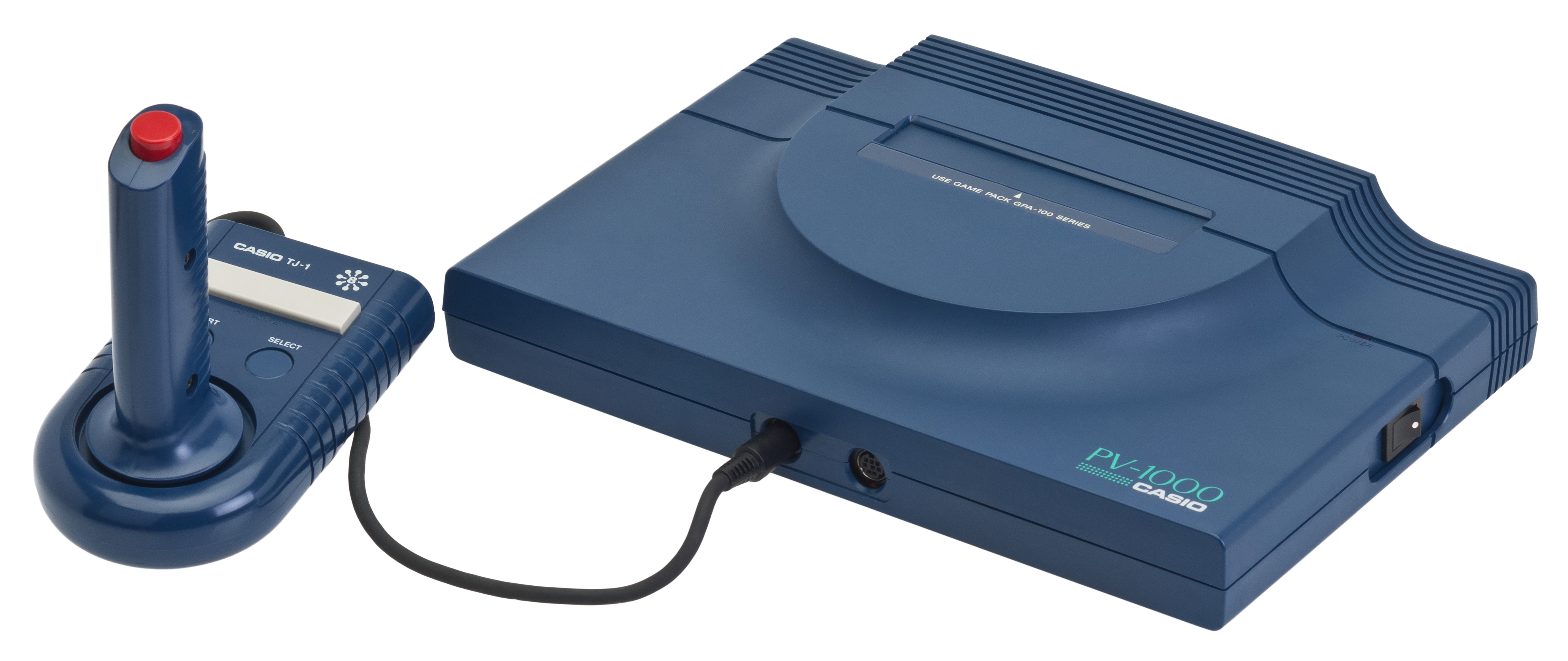
1983 was a terrible year for video gaming in the US, The once mighty industry was crashing at blistering speed, and consoles were being discontinued left and right. In Japan, the story was the polar opposite. The video game industry was in a time of great innovation at the time, led by the introduction of the Nintendo Famicom in July of that year. Casio had experience porting games to the MSX computers in Japan, and decided to throw their hat into the thriving Japanese console market, releasing the PV-1000 in October 1983.
The system used the Zilog Z80 processor, also used in the ColecoVision, and used a joystick controller much like most other early 1980s consoles.
What Makes It Obscure?
The PV-1000's October 1983 release put it into direct competition with the Nintendo Famicom (later sold as the NES) and Sega SG-1000, each of which had vastly superior technical specs and third party support. Only 15 games were ever released for the system, mostly ports of popular arcade games of the time. The system was said to have been produced only for a period of a few weeks, and is extremely rare today.
In short, the system failed because it was competing with two vastly superior systems.
Thursday, April 16, 2015
The Super A'Can

The Super A'Can is a video game console released in Taiwan on October 25, 1995. Although it is often compared to the Super Nintendo, it is, in many ways, cosmetically more like the SNES and internally more like the Sega Genesis. The system has an SNES-like control pad and appearance, but Sega Genesis-like internals - for instance, the system used the same Motorola 68000 processor as the Genesis. The system is not compatible with the Genesis (or SNES for that matter). The system was developed by a Taiwanese company called Funtech specifically for the Taiwanese market, and was not a pirated system. The system was graphically about on par with the SNES, and most of its games are similar in gameplay to popular SNES games of the time.
What Makes It Obscure?
Even in Taiwan, the system was not a great success. Had the system been released two years earlier, it likely would have seen much more success. The late 1995 release of the system put it in competition with the 32 bit systems such as the PlayStation and Sega Saturn, and the Super A'Can was a generation behind. The system was eventually discontinued. (A discontinuation date wasn't found, but is likely around 1997). Only 12 games were released for the system. Combine that with a total lack of release outside Taiwan (in the mid-2000s, it was said that only four systems were outside Taiwan) and you have a very obscure console on your hands.
The Dendy - A Russian NES Clone


Background/History:
The Dendy is a video game console sold in Russia from 1992 to 1996, made by a company called Steepler. It was a Taiwanese produced clone of the Nintendo Entertainment System (NES), exclusively produced for the Russian market. As the NES was never produced in an official capacity for the Russian market, the Dendy was the only video game console on Russia's market at its introduction in late 1992. Most of the games were pirated copies of NES games. Some games were originally programmed, but most of these were still copyright infringing: one of these games was Somari, a clone of Sonic the Hedgehog with the Mario character. Many multicarts (cartridges with multiple games on them) were produced. The cartridges looked much like Famicom (the Japanese version of the NES) cartridges.
The initial price was 39,000 rubles (about $94), limiting its sales as the price was equivalent to a month's salary for an average person. By 1994, the price was down to $30-$35, and over a million had been sold, with an additional 100,000-125,000 units being sold on a monthly basis. In 1994, the Dendy's success spurred Sega to introduce their Genesis console to the Russian market. Steepler was reorganized into the Dendy company, and in November 1994 signed an agreement that Dendy the exclusive rights to sell the newer Super Nintendo console in Russia. It is unclear how the Dendy was discontinued: one theory suggests that Dendy signed a deal with Nintendo to sell licensed cartridge games in lieu of pirated games. Since licensed games cost several times more than pirated games, they were not affordable to the Russian market.
What Makes It Obscure?
The Dendy was the first successful console on the Russian market, but it was exclusively sold in Russia. It has aspects of it that are unlike any licensed console, and to the Western eye, it looks like what it is - a knockoff.
Tuesday, April 14, 2015
The VideoBrain

Background/History:
The Video Brain Family Computer is yet another system that blurs the line between home computer and video game system. Developed by a startup company called Umtech, the system was based the Fairchild F8, the same microprocessor as the Fairchild Channel F. It featured a kilobyte of RAM and four kilobytes of ROM, and was capable of 16 color graphics. The VideoBrain was marketed as a "family" home computer, and it featured video games as well as productivity software. The system featured four built in programs: a text editor, clock, countdown timer, and color bar generator. Additional software was available on cartridges that could hold 12 kibibytes (about 12.3 kilobytes) of data. The system shipped with one cartridge, a program called Financier that could be used to solve financial equations.
What Makes It Obscure?
The system had several hard to use features. The system did not use BASIC, the common computer language of the time: it used APL/S, forcing users to adopt a programming language that was not in common use. The keyboard made text entry a tedious task. In addition: the system was poorly marketed. It was primarily available through mail order, although Macy's did sell the system briefly. The price on the system was also steep: at introduction, $500 ($1,815 in today's dollars) got you a system with three cartridges. Educational and video game cartridges were $20-40 (now $73-146). Only fourteen programs were ever released.
The system, released in March 1978, was one of the few systems to be discontinued before the end of the 1970s. Production ended in spring 1979.
The Channel F, the first programmable video game console and the system that donated its microprocessor to the VideoBrain, was introduced over a year earlier - November 1976 - and ended production in 1981.
Thursday, April 9, 2015
Pioneer LaserActive

Background/History:
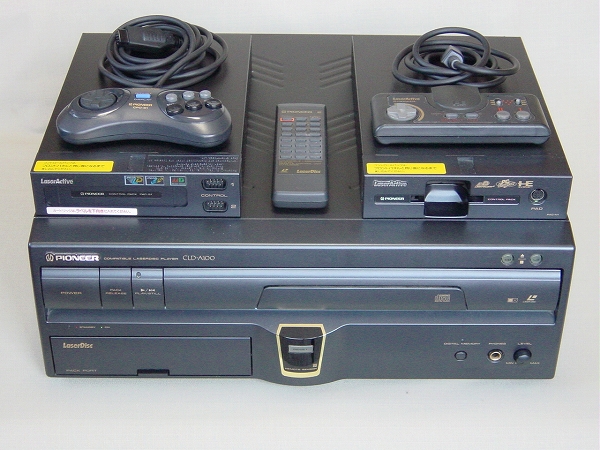
The LaserActive was a laserdisc based system, like the RDI Halcyon, but far more successful. Released on August 20, 1993 in Japan and September 13, 1993 in the US, the LaserActive was unique in that it required two components to work as a video game console. The base component was a laserdisc player, the Pioneer CLD-A100, and the second component was the PAC module. By itself, the base component could play standard laserdisc movies and CD-ROMs. There were two available PAC modules, each able to play their own library of laserdisc games. The PAC modules were not region locked, and could play games released anywhere in the world. Both PACs could be attached at once.
The Sega PAC, released by Pioneer and Sega, had a library of laserdisc games (called Mega LD) and could also play the full library of Sega Genesis/Mega Drive and Sega CD titles. Around 40 Mega LD discs were released. The NEC PAC, released by Pioneer and NEC, has a separate library of laserdisc games (called LD-ROM2), as well as being able to play TurboGrafx-16 and TurboGrafx-CD games. (The TurboGrafx-16 games were region locked). Around 15 LD-ROM2 games were released.
The game genres covered a wide range.
There was also a karaoke module available, as well as 3D glasses.
What Makes It Obscure?
Quite simply, price and value. The LaserActive was state-of-the-art; however, high technology is not cheap. The base unit cost $970, and each PAC was $600 extra. A LaserActive with the Sega PAC would set you back $1,570, before games. Adjusted for inflation, this is $2,550. While this sum got you a hefty library of thousands of games to choose from, keep in mind that a new Genesis and Sega CD could be bought for around $350 at the time ($569 today) and could play all US-released games other than the Mega LDs. In effect, this was a $1,220 premium ($1,981 today) to be able to play 40 Mega-LD games and imported games.
The LaserActive with the NEC module was also $1,570, but its game library was far smaller. The TurboGrafx line was much less successful and saw much fewer game releases than the Sega Genesis and CD did. The TurboDuo, a unit integrating the function of a TurboGrafx-16 and TurboGrafx-CD, could be bought for around $300 at the time ($487 today), and even offered an adapter to play games from different regions for both. In effect, this was a $1,270 premium ($2,063 today) to be able to play 15 Mega-LD games and have an inability to play foreign TurboGrafx-16 games.
If one used the LaserActive as a standalone Laserdisc player and CD player, the value proposition was better, but even a good laserdisc player, CD player, and game console were still far less expensive than a LaserActive. However, the value was not so bad as to prevent the system's release, and unlike the Halcyon, the LaserActive with Sega PAC did offer a large game library with the high price. The Halcyon came into a dead video game market. The LaserActive arrived into a lively video game market.
About 10,000 LaserActives were sold. Today a LaserActive and Sega PAC can still be bought for under $1,000.
Tuesday, April 7, 2015
Apple Pippin


Background/History:
Apple has had two "golden ages" in its 39 year history. The first golden age was in the 1980s, and was led by the Apple II and early Macintosh computers. The second has been since around 2000 and has been led by many products - the iMac line, the iPod, the iPhone - iGuess you could call it the iEra. But in between that first and second golden age came Apple's dark age: the 1990s. Many of Apple's products during the '90s were underperforming.
One of Apple's biggest flops was the Pippin, their attempt to enter the video game market. The system was designed to compete with the "fifth generation" systems, namely the PlayStation, Nintendo 64, and Sega Saturn.
The system featured a 66 MHz PowerPC processor, making it similar in architecture to many early-mid 1990s Macintosh computers.The console also featured Internet connectivity. It offered a choice of 14.4, 28.8, or 33.6 kbit/s modems. Some games featured online play, and the system could be used to access the internet. In effect, the idea was for it to be a low end Macintosh computer - game console hybrid.
Like the 3DO, Apple created the hardware standard and third parties produced the system. In this case, two companies - Bandai and Katz Media (a Norwegian company) - manufactured the systems themselves. The Bandai Pippin launched in Japan on March 28, 1995 and in the USA on September 1, 1995. The Katz Media Pippin was sold in Europe and Canada, and launched on March 17, 1997.
What makes it obscure?
Like most obscure systems, this one was a flop. The main problem was the outdated technology. When the system was conceived in 1993, home computer prices were high and the game console market was dominated by 16 bit systems such as the Sega Genesis and Super Nintendo. At that time, the system's technical specs would have been impressive - it was leaps and bounds ahead of the 16 bit systems. In the two years between the system's conception and launch, home computer prices plummeted, even as the computers themselves became more powerful. On the game console front, the 16 bit era was coming to an end. The $599 Pippin launched around the same time as the 32 bit Sony PlayStation and Sega Saturn, systems that were cheaper and far more powerful. One critic said that the Pippin tried to "market 1993 technology to a 1996 audience." The internet connectivity was also slow. By 1996-1997, 56 kbit/s modems were becoming common.
The Pippin was a classic case of too little, too late.
Subscribe to:
Posts (Atom)